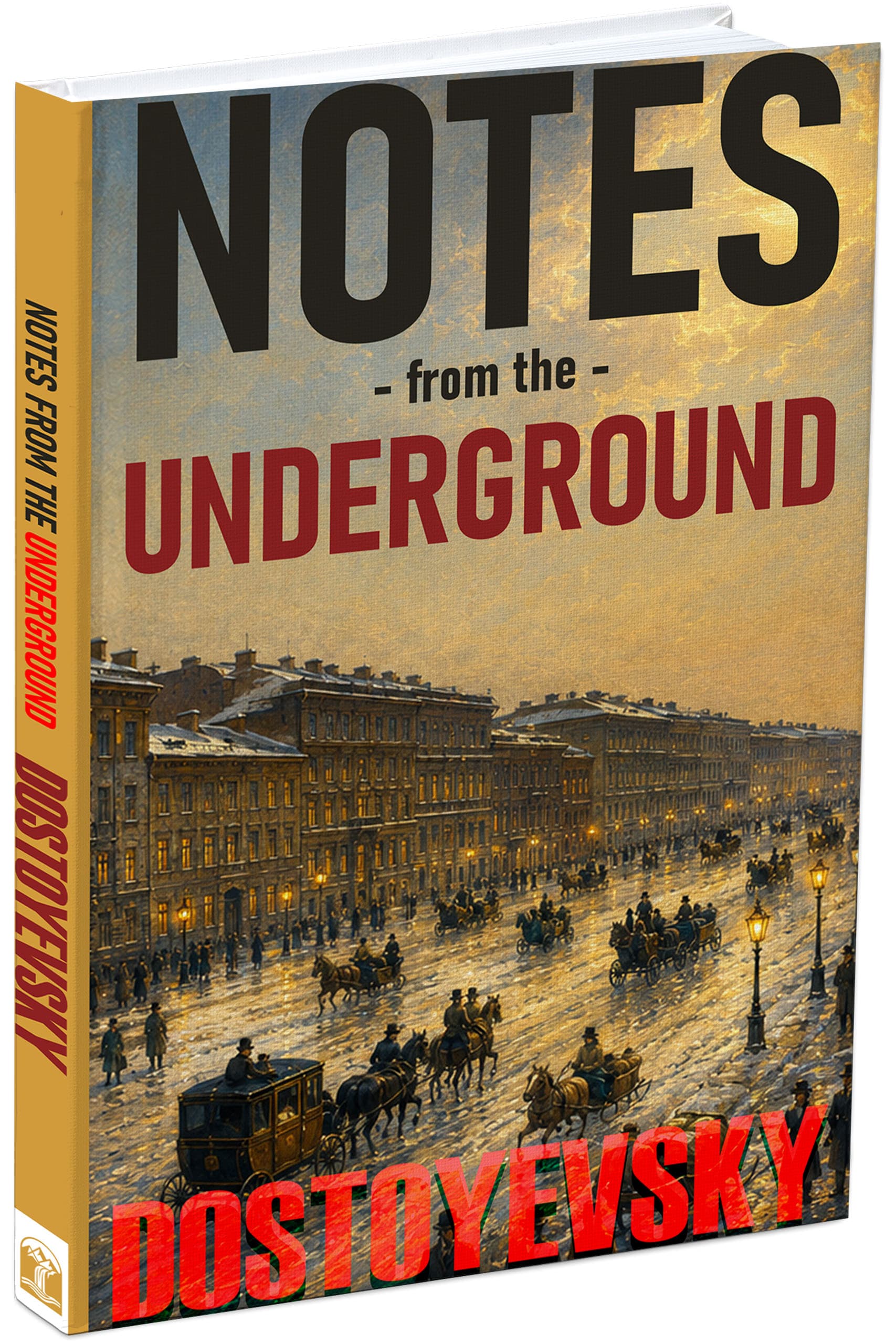
Notes from Underground

Notes from Underground

This product is currently out of stock and unavailable.

A man of spite. A mind without mercy.

Forty years old and consumed by bitter hate, a man retreats from society into a cramped St. Petersburg apartment. From this underground he addresses an unnamed audience directly, spilling out a philosophy built entirely in opposition: to reason, to progress, to the tidy arithmetic of human happiness that thinkers of his age promise will perfect mankind. He insists on his own perversity as a kind of freedom, the one thing no formula can predict or take from him.

Then the confession turns backward, to the humiliations that made him this way. A dinner with former schoolmates who despise him. A prostitute named Liza, to whom he offers rescue and cruelty in the same breath. Each encounter strips away another layer of the false self he has constructed, until what remains is a man who understands his own damage with total clarity and still cannot stop causing it.

Fyodor Dostoevsky wrote this novella as a critical response to the utopian socialism fashionable among Russian intellectuals of his day. In doing so, he produced something stranger and more durable: the first true portrait of the modern antihero, a mind so relentlessly self-aware it corrodes its own capacity for happiness and connection.

“I swear, gentlemen, that to be too conscious is an illness — a real thorough‑going illness.”

About the Author

Fyodor Mikhailovich Dostoevsky was born in Moscow in 1821, the son of a staff doctor at a hospital for the poor. He trained as a military engineer but abandoned the profession for writing, publishing his first novel, Poor Folk, in 1846 to instant acclaim. In 1849, he was arrested over his membership in a radical literary circle, sentenced to death, and led before a firing squad — only to receive a last-minute commutation to four years of hard labor in Siberia. He served his sentence, completed his military service, and returned to writing. 

Notes from Underground, published in 1864, marked his return to major fiction after years of financial hardship and personal loss, including the death of his first wife. It became the hinge between his earliest work and later critical success. Crime and Punishment, The Brothers Karamazov — the great novels that follow all descend from this voice: a mind too honest about its own cruelty and too proud to ask forgiveness.

The underground man’s bitter, brilliant voice has echoed through the century that followed, claimed as an ancestor by writers and philosophers from Friedrich Nietzsche to Jean-Paul Sartre. Few works of fiction have exerted so much influence on how literature imagines the inner life of a mind at war with itself.

More Books You’ll Love